Good Neighbor Next Door Program in Colorado: Eligibility, HUD Homes & How It Works

Buying a home can feel overwhelming. If you are a Colorado teacher, law enforcement officer, firefighter, or emergency medical technician, the Good Neighbor Next Door program may make the process more affordable. An eligible buyer may be able to purchase a select HUD home for 50% off the list price. With qualifying FHA financing, the down payment may be as little as $100.
Those benefits sound exciting, but the program has important rules. The buyer, job, home, location, and loan all need to qualify. Eligible homes are also hard to find. This guide breaks everything into simple steps so you can understand the program without feeling like you need to become a mortgage expert.
What Is the Good Neighbor Next Door Program?
The Good Neighbor Next Door Sales Program, also called GNND, is offered by the U.S. Department of Housing and Urban Development, or HUD. It helps certain community professionals buy a HUD-owned home in an area HUD is working to improve.
The program does not work with every home for sale. You cannot choose any Colorado house and ask HUD to take 50% off the price. The home must be owned by HUD, approved for the program, and located in a HUD-designated revitalization area. In plain English, that means HUD has chosen the home and neighborhood for this special program.
Good Neighbor Next Door Benefits at a Glance
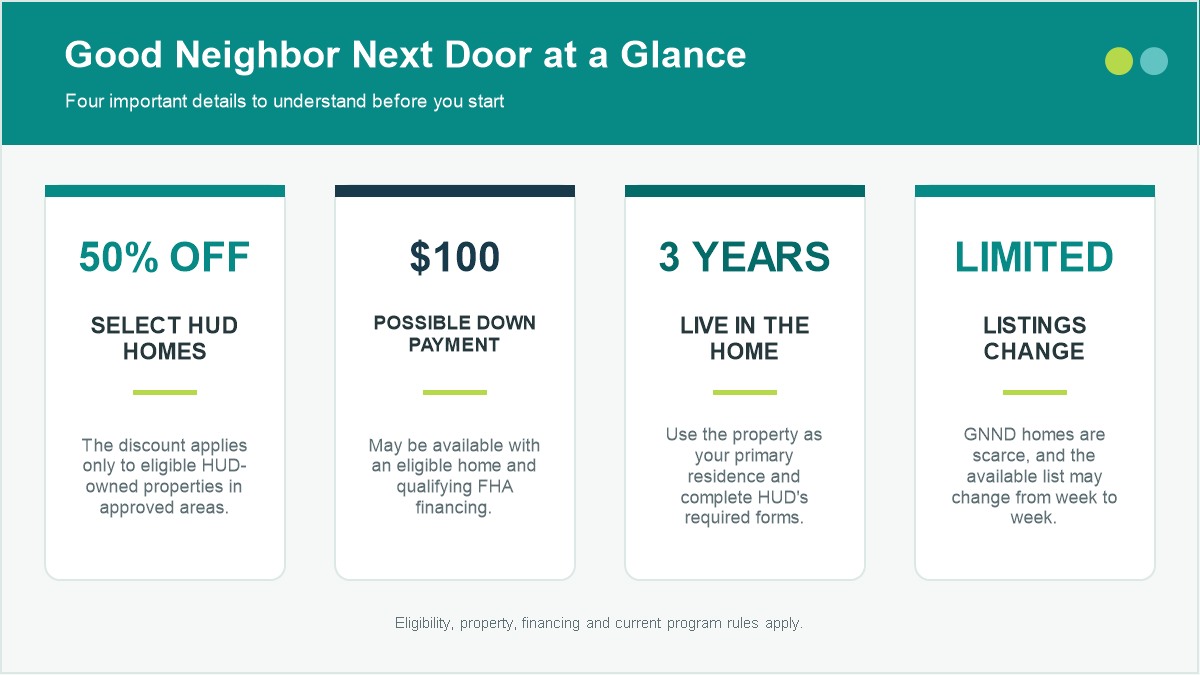
- 50% off the list price of an eligible Good Neighbor Next Door home
- Possibly as little as $100 down with qualifying FHA financing
- A choice of FHA, VA, conventional financing, or cash
- A possible FHA 203(k) renovation loan if the home needs repairs
- A chance to buy a select HUD home before it is offered to other buyers
You still need to qualify for your mortgage. A lender will review your income, credit, debts, savings, and the home itself. You may also need money for closing costs, inspections, insurance, and repairs. Jerry can help you understand what may apply before you make an offer.
How the 50% Good Neighbor Next Door Discount Works
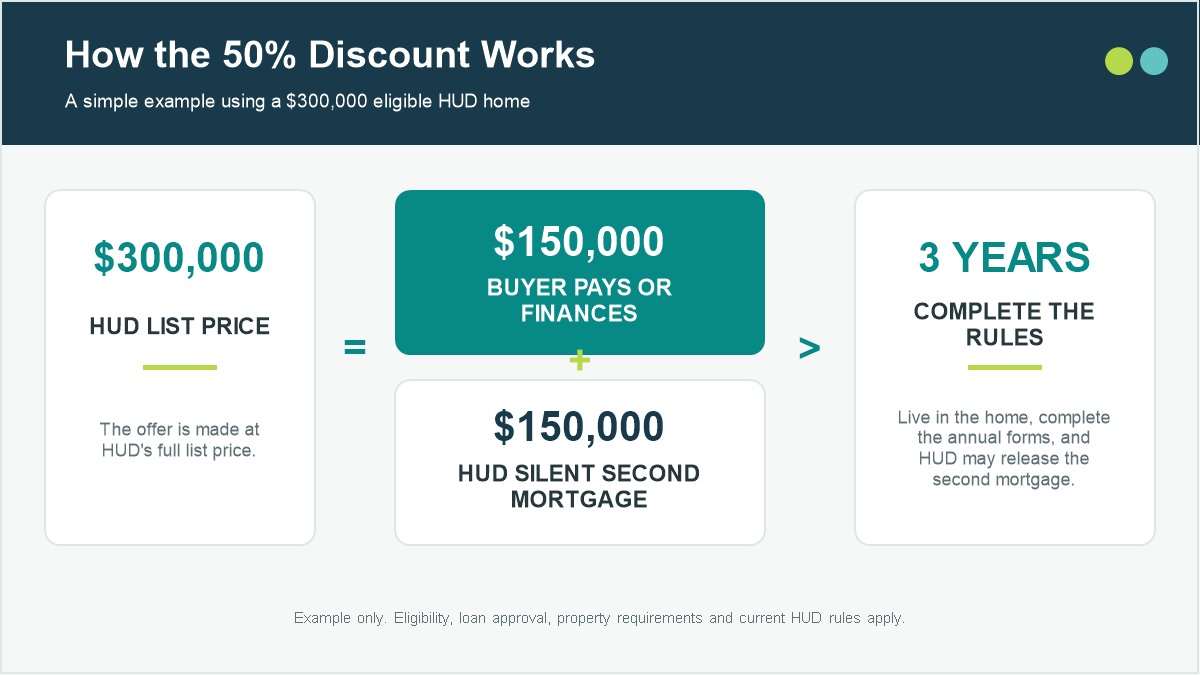
You make an offer at HUD’s full list price, but you pay or finance only half of that amount at closing. HUD keeps track of the other half with a second mortgage. This second mortgage protects the discount while you complete the program’s three-year living requirement.
Here is a simple example. If an eligible HUD home is listed for $300,000, the discounted price would be $150,000. HUD would record a second mortgage for the other $150,000. This is only an example. The price, loan, costs, and homes available in Colorado will be different for every buyer.
What Is the Silent Second Mortgage?
The HUD second mortgage is often called a silent second mortgage. “Silent” means you do not make a monthly payment on it, and it does not charge interest while you follow the program rules.
You must live in the home for three years and complete the forms HUD sends you each year. After you finish those requirements, HUD can release the second mortgage. If you move, sell, or stop using the home as your main home too early, you may have to repay part or all of the discount. Talk with HUD and your loan professional before selling or refinancing during those three years.
How the $100 Down Payment Option Works
If you qualify for Good Neighbor Next Door and use qualifying FHA-insured financing, your down payment may be only $100. In some cases, certain closing costs may be included in the FHA loan. The home, loan amount, appraisal, and current program rules all matter.
Keep in mind that “$100 down” does not mean “only $100 needed.” You may still pay for an inspection, earnest money, taxes, homeowners insurance, mortgage insurance, repairs, and other closing costs. Once you choose a home and loan, your lender will give you a clearer estimate of how much money you may need.
Could $100 Down Apply Without the GNND Discount?
It may. HUD also has an FHA $100 Down Sales Incentive for certain HUD-owned homes. A buyer who does not qualify for the Good Neighbor Next Door discount may still find an eligible HUD home that allows qualifying FHA financing with as little as $100 down.
Not every HUD home offers this option. The property listing, the FHA loan, and the lender must all allow it. Jerry can help check whether a Colorado home is eligible and whether FHA financing through UWM or another available lending option may fit your needs. Approval is never automatic.
Who Qualifies for the Neighbor Next Door Program?
The GNND program is for four groups of full-time community professionals. Your job title is only the starting point. HUD will also look at who employs you and whether you serve the area where the home is located.

Law Enforcement Officers and Police Officers
You may qualify if you work full time for a federal, state, local, or tribal law enforcement agency. You must be sworn to uphold the law and make arrests. Your normal work must directly serve the area where the home is located.
Pre-K Through 12 Teachers
You may qualify if you are a full-time teacher at a state-accredited public or private school serving students from pre-kindergarten through grade 12. The students you normally serve must come from the area where the home is located.
Firefighters and Emergency Medical Technicians
You may qualify if you work full time as a firefighter or emergency medical technician for a federal, state, local, or tribal fire department or emergency services unit. Your normal work must serve the area where the home is located.
Other first responders, military members, school employees, healthcare workers, volunteers, and public servants do not qualify based on those jobs alone. They would need to meet HUD’s definition for one of the four approved professions.
Other GNND Buyer Eligibility Rules
You do not have to be a first-time homebuyer. However, HUD’s current GNND consumer fact sheet says that you and your spouse generally cannot own another home when you submit your offer or during the 12 months before your offer.
You must plan in good faith to stay in your eligible full-time job for at least one year after closing. You must also qualify for your chosen loan. GNND does not have one simple household income limit, but your income, credit, savings, debts, and job history will affect the mortgage options available to you.
What Homes Are Eligible in Colorado?
The 50% discount applies only to select HUD-owned single-family homes in approved areas. An eligible property might be a detached house, townhouse, or condo. HUD sells these homes “as is,” which means HUD will not fix the home or provide a home warranty.
GNND homes are usually listed for the program for seven days. If more than one qualified buyer wants the same home, HUD chooses the buyer through a random lottery. Available properties are limited, and the list can change every week. This is why you may see no Colorado homes one week and a new listing later.
Why Limited Inventory Matters
You cannot control when an eligible home becomes available. It helps to review your job and loan eligibility first, so you are better prepared when the right home appears. You may need to act quickly, but you should never feel rushed into skipping an inspection or ignoring repair costs.
It is okay if there is no home available today. Checking the listings regularly and having a plan can make the process feel much more manageable.
How to Buy a Good Neighbor Next Door Home
- Check your job eligibility. Make sure your profession, employer, and service area meet HUD’s rules.
- Talk about financing. Review FHA, VA, conventional, and cash options. Ask about the $100-down option before you bid.
- Watch for Colorado HUD homes. Check the HUD Home Store regularly because listings may change weekly.
- Choose a HUD-registered real estate broker. The broker helps you find the home and send your offer to HUD.
- Offer the full list price. HUD does not negotiate the GNND list price. The program applies the 50% discount separately.
- Wait for the result. If several qualified buyers want the same home, HUD uses a lottery.
- Review the home and loan carefully. Look at the inspection, appraisal, repairs, insurance, monthly payment, and closing costs.
- Close and move in. You will sign your loan papers and HUD’s second mortgage for the discount amount.
You do not need to remember every step on your own. A loan professional and HUD-registered real estate broker can guide you through the parts they handle and tell you what comes next.
Financing, Closing Costs, and Repairs
You can use an FHA loan, VA loan, conventional mortgage, or cash to buy a GNND home. The $100-down benefit is connected to qualifying FHA financing. Some state or local down payment assistance programs may also work with GNND, but every program and lender must approve the combination.
A small down payment does not always mean a small monthly payment. Ask for an estimate that includes the interest rate, mortgage insurance, property taxes, homeowners insurance, homeowners association fees, and possible repair costs. Looking at the full monthly cost can prevent surprises later.
If a temporary rate buydown is available, ask what the payment will be after the temporary period ends. Focus on the permanent loan terms and make sure the long-term payment feels comfortable for your budget.
What If the HUD Home Needs Work?
Some HUD-owned homes need repairs. An FHA 203(k) renovation loan may let you include approved repair costs in your mortgage. Whether this works depends on the home’s condition, the type of repairs, the appraisal, contractor information, and loan rules.
Always consider an independent home inspection. The 50% discount may be valuable, but you still need to understand the roof, heating and cooling systems, plumbing, electrical system, safety concerns, insurance, and possible repair budget.
The 36-Month Primary Residence Requirement
You must use the GNND home as your main home, also called your primary or sole residence, for 36 months. Depending on the home’s condition, HUD may allow you to move in 30, 90, or 180 days after closing. HUD will send a form each year asking you to confirm that you still live there.
This program may not be the right fit if you expect to move soon, rent out the property, or buy it as an investment. The discount is meant for community professionals who plan to live in the neighborhood for at least three years.
Good Neighbor Next Door Program Pros and Cons
The main benefits are the 50% discount, the possible $100-down FHA option, and early access to an eligible HUD home. For the right buyer and property, those benefits can make homeownership much more reachable.
The challenges are the limited number of homes, the short seven-day listing period, the lottery when several buyers are interested, as-is property condition, job and location rules, the second mortgage, and the three-year living requirement.
There is no need to decide based on the benefits alone. Start by checking your eligibility, likely monthly payment, repair risk, and how long you plan to live in the home.
Frequently Asked Questions
No. You do not need to be a first-time buyer. You and your spouse generally cannot own another home when you make the offer or during the previous 12 months.
No. The discount works only with eligible HUD-owned homes listed through the GNND program in HUD-approved revitalization areas.
No. The $100 down payment requires an eligible home and qualifying FHA-insured financing. Other homes and loan types have different down payment rules.
No monthly payment or interest is required while you follow the program rules. HUD can release the second mortgage after you complete the three-year living requirement and required forms.
There is no set schedule. HUD says the number of homes is limited and the available list changes weekly. Getting prepared first can help you act when a suitable home appears.
Explore Current Colorado HUD Home Options
Good Neighbor Next Door can be a powerful opportunity, but you do not have to sort through every rule by yourself. The first step is simply finding out whether your job, location, financing, and current HUD homes might fit together.
The separate FHA $100 Down Sales Incentive may also help some buyers who do not qualify for the GNND 50% discount. Because the option depends on the home and loan, it is important to check the current details before making plans.
Want to see which Colorado properties may be available? Schedule a free consultation with Jerry Cusick. He will help you check your eligibility, explain the financing options that may fit, and review current eligible homes with you—one simple step at a time.
This article provides general information and is not a promise to lend or a guarantee of approval, property availability, rate, or payment. Programs and lender rules can change. Please confirm current HUD, FHA, UWM, property, and loan requirements before making a decision. Equal Housing Opportunity.
